.png)
Direct Answer for Switzerland Teams
How can Swiss finance and pharma teams use AI while preserving trust, confidentiality, privacy, and audit-ready evidence? The practical answer is to treat AI as a governed workflow layer, not as a collection of disconnected chatbot subscriptions. For Swiss finance and pharma, AI governance should define who may use AI, which data classes may enter prompts, which model routes are approved, which workflows require review, who owns budget, and what evidence is retained after the request. A written policy helps, but it is not enough if employees can still paste sensitive context into an unmanaged model before the policy has any chance to act.
The operating model should start with the highest-demand workflows and make the approved path easier than the workaround. In this market, the first workflows are usually private-client summary drafting; research literature review; quality record analysis; contract review; and engineering support. Each workflow needs a named owner, allowed data classes, allowed models, retention rules, review requirements, and escalation paths. Those rules should map to runtime decisions: allow, warn, redact, block, reroute, require approval, or create an exception record. Remova is relevant because it gives teams one governed AI workspace for AI for financial services, AI for healthcare, compliance team AI governance, sensitive data protection, audit trails, instead of forcing every department to interpret AI policy on its own.
Buyer Questions This Guide Answers
Teams evaluating AI governance in Swiss finance and pharma are usually past the awareness stage. The question is no longer whether employees will use generative AI. They already will. The buyer question is whether the company can approve useful AI workflows with enough visibility, data protection, model control, review discipline, budget ownership, and audit evidence to satisfy security, privacy, compliance, finance, and business owners at the same time.
That turns the buying process into a practical control review. Which workflows should be approved first? Which data classes are prohibited, redacted, or routed differently? Which models and vendors are acceptable for sensitive work? Which roles can use each workflow? Which outputs require human review? Which evidence will prove that the controls operated later? Buyers usually want to understand how to prove AI control in high-trust environments where confidentiality, data protection, vendor assurance, and regulated workflow evidence matter. A strong buying process should test whether the platform enforces these decisions in the workflow, not only whether it describes governance well in a sales deck.
Switzerland Market Context
Swiss finance and pharma organizations often combine strict confidentiality, customer or patient trust, cross-border collaboration, and regulated operating models. AI can help with research, support, analysis, document review, engineering, and internal knowledge work. The control problem is making those workflows useful without making data movement opaque. That matters because AI requests are not isolated technical events. A prompt may contain business strategy, regulated data, internal code, customer records, employee information, supplier terms, or operational details. It may also trigger retrieval, tool calls, draft outputs, downstream exports, or model routes that have different privacy and security profiles. The governance layer has to see the full path, not only the final response.
For Swiss banks, insurers, wealth managers, pharmaceutical companies, medtech teams, research organizations, and regulated technology vendors, local relevance comes from the combination of industry expectations and day-to-day work patterns. Employees are not asking abstract governance questions. They are asking whether they can summarize a document, draft a reply, debug a problem, analyze a spreadsheet, search internal knowledge, or automate a repeated task. That is why broad policy language becomes weak unless it is attached to workflow controls. The strongest programs connect local context to named workflows, concrete data classes, and evidence that can be reviewed by security, privacy, legal, finance, or business owners.
Facts and Source Baseline
A factful Switzerland AI governance program should start from authoritative sources and then translate them into operating controls. Useful reference points for buyer due diligence include Swiss Federal Data Protection and Information Commissioner, NIST AI Risk Management Framework, ISO/IEC 42001, OWASP Top 10 for LLM Applications, Microsoft 365 Copilot enterprise data protection. These sources do not say that buying one AI tool automatically creates compliance. They point in the opposite direction: organizations need governance, risk assessment, accountability, security controls, privacy review, supplier awareness, and evidence that controls actually operate.
The practical interpretation is conservative. Do not claim that any platform guarantees compliance with a law, standard, or regulator. Instead, document the controls that support the program: inventory, scope, ownership, data handling, model access, redaction, role access, vendor review, output review, incident response, monitoring, and audit evidence. For Swiss finance and pharma, the defensible position is that AI governance helps the company make better-controlled decisions and preserve evidence for review. Legal teams still need to confirm applicability, especially when AI output affects customers, employees, regulated decisions, clinical or financial workflows, or cross-border data movement.
The Local Risk Scenario
A private-client team uses AI to summarize wealth-management notes, a pharma operations team asks a model to analyze research or quality records, or an engineer uses a coding assistant with sensitive integration logs. The event needs a record of user, purpose, data class, model route, review rule, and policy result so privacy, compliance, and security teams can reconstruct it. This is the point where many AI rollouts fail. Teams evaluate the model vendor, publish acceptable-use language, and train employees, but they do not control the prompt path. Once sensitive content reaches a model route that was not reviewed, the organization is left reconstructing the event from browser history, user memory, or generic logs. That is too weak for a production app, a regulated workflow, or a serious customer assurance request.
The control objective is not to stop every AI request. It is to classify and handle requests correctly. If a prompt contains private-client records, patient-adjacent information, clinical research context, quality records, intellectual property, supplier data, source code, and cross-border collaboration notes, the platform should know what data class is present before the request leaves the workspace. Depending on policy, it may redact specific entities, block the request, route it to a safer model, require review, or log an exception. The key is that the decision happens inline and is attached to the user, workflow, model route, and evidence record.
Control Model: User, Data, Model, Workflow, Evidence
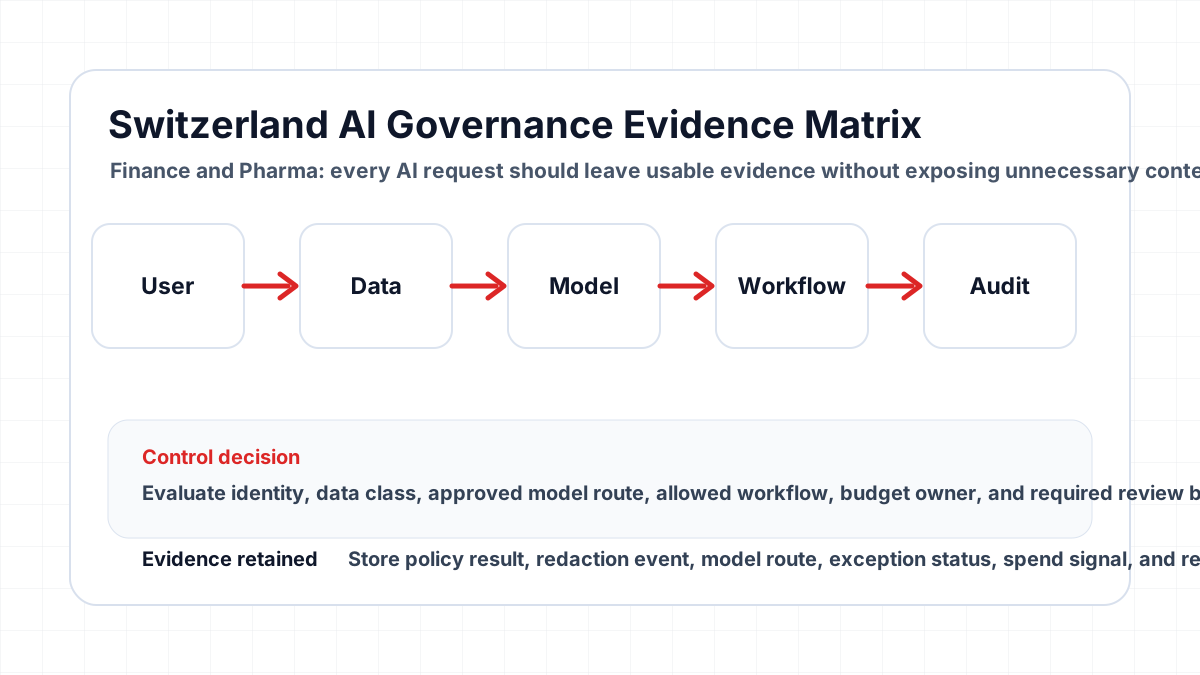
Use a five-part control model for Swiss finance and pharma: user, data, model, workflow, and evidence. User controls determine who is acting, which team they belong to, and which capabilities they may access. Data controls inspect prompts, files, retrieved context, and outputs for sensitive content. Model controls decide which approved provider, deployment, region, or route can receive the request. Workflow controls define whether the task is allowed, reviewed, budgeted, or restricted. Evidence controls retain enough metadata and policy history to reconstruct what happened without exposing more prompt content than necessary.
The primary control emphasis for this market is confidentiality-aware access, data minimization, prompt redaction, approved model routing, human review, and audit-ready evidence. That emphasis should show up in product settings, not only in a governance slide. For example, a high-risk workflow should have a named owner, allowed users, allowed data classes, allowed model routes, output review requirements, and a logging rule. A lower-risk workflow may only need model access, basic sensitive-data checks, and usage analytics. The right control level should depend on data sensitivity, business impact, user role, and downstream use.
Implementation Plan
Start with a 30-day control sprint. First, inventory the top AI workflows already happening in Switzerland. Interview team leads, review proxy logs where available, inspect approved vendor usage, and ask employees which AI workarounds they already use. Do not turn this into a blame exercise. Shadow AI often means employees found an unmet need before the official process did. The goal is to discover workflows, data classes, tool routes, and failure modes quickly enough to design a sanctioned alternative.
Next, approve a small set of governed workflows. 1. private-client summary drafting 2. research literature review 3. quality record analysis 4. contract review 5. engineering support For each workflow, define the owner, input data classes, approved model route, user groups, review rule, retention setting, budget owner, and evidence source. Then test with realistic prompts, including sensitive-data examples, prompt-injection attempts, stale documents, low-quality files, and role-mismatch scenarios. Only expand once the team can answer basic audit questions: who used it, what policy applied, what data class was detected, which model route was used, what was redacted or blocked, and who reviewed exceptions.
Evidence Matrix for Audit and Customer Assurance
The evidence layer should be designed before the first broad rollout. For Swiss finance and pharma, the evidence emphasis is purpose, user identity, data class, redaction result, cross-border route, model vendor, review outcome, and exception status. Evidence should come from normal operation, not from screenshots created after an audit request arrives. If a control is important enough to claim in a security review, it should produce a record when it operates. That record should be scoped so sensitive prompt content is protected, but complete enough for authorized reviewers to understand the event.
Build a matrix with six columns: control, workflow, owner, enforcement point, evidence source, and review cadence. A sensitive-data policy may be enforced before the model call and evidenced by detection, redaction, block, or route decisions. A role-access policy may be enforced at login or request time and evidenced by identity group, workspace, model access, and denial events. A model-governance policy may be enforced at routing time and evidenced by selected vendor, model, region, and exception status. This matrix becomes useful for audits, customer security questionnaires, management reviews, and incident response.
Metrics That Show Whether Governance Is Working
A serious AI governance program should measure more than prompt count. For Switzerland, useful metrics include confidential-data redactions; regulated workflow coverage; approved model route usage; exceptions by age; and audit evidence completeness. Add user satisfaction and output rework because a control program that employees avoid will push usage back into personal tools. Add exception aging because old exceptions often reveal policy drift, missing workflows, or unresolved business pressure. Add budget variance because model choice and workflow design can turn into recurring cost if no owner is accountable.
Metrics should be reviewed by a cross-functional owner group, not dumped into a dashboard that nobody reads. Security should review sensitive-data events, tool misuse, prompt-injection signals, and incident reconstruction time. Privacy or compliance should review high-risk workflows, retention settings, evidence completeness, and exception records. Finance should review spend by department, model route, and workflow. Business owners should review adoption, output quality, cycle-time improvements, and employee friction. Governance becomes durable when these groups can make decisions from the same evidence.
How Remova Fits
Remova fits this Switzerland use case as an enterprise AI control layer. The product position is not that Remova replaces every model or every vendor. The useful role is to route employee and application AI work through a governed workspace where policies, data checks, model access, role access, budgets, usage analytics, and audit trails operate together. That is especially important when employees need multiple models but the company needs one place to enforce rules and retain evidence.
For Swiss compliance, privacy, security, legal, research, technology, and AI governance leaders, the practical Remova workflow is straightforward. Define the approved workflows, map them to user groups, set model routes, apply sensitive-data protection, enforce policy guardrails, attach department budgets, and monitor usage. When a request violates policy, the user should receive clear guidance and the reviewer should receive useful evidence. When a workflow is allowed, the event should still create a record that shows the request followed the approved path. Sign up for Remova if your team needs governed AI usage with controls close to the actual prompt path.
Checklist for the First Governance Review
Use this checklist before expanding AI usage in Swiss finance and pharma. Confirm that the top workflows are inventoried and owned. Confirm that approved model routes are documented. Confirm that sensitive data is detected before model calls. Confirm that role-based access maps to real identity groups. Confirm that prompts, files, retrieval context, and outputs have policy handling. Confirm that exceptions have owners and expiry dates. Confirm that high-impact outputs require human review. Confirm that spend is tied to a department or workflow owner. Confirm that audit evidence can be exported or reviewed by authorized teams.
The final question is whether the sanctioned path is better than the workaround. If the approved workflow is slow, confusing, or missing the model employees need, people will move around it. If the approved path is useful, fast, and clear, governance becomes part of the work instead of a separate compliance burden. The buyer-facing standard is practical: make the local decision easier, make the operating model concrete, and make the evidence useful after rollout.